Custom Application Software Development
From Concept to Code — We Build Scalable, Secure, and Future-Ready Applications


Manage your business easily and efficiently
Choose the solution that suits you best

Binance P2P Telegram Bot - Auto Chat, Order Tracking & Instant Crypto Release
Control your entire Binance P2P workflow from Telegram — chat, pricing, payments and crypto release in seconds.
Detail →

Binance P2P Trade Bot – Self-Hosted Automatic Repricing and Competitor Tracking Software
Self-hosted Binance P2P bot with automatic repricing, competitor tracking and real-time market monitoring. Automate your ads, stay competitive and operate 24/7 on your own VPS or computer
Detail →
OKX P2P Trade Bot - Automated Repricing & Telegram Order Management
OKX P2P Trade Bot is automated P2P trading software for OKX with competitor price tracking, automatic ad repricing, and Telegram order management. Monitor buy and sell orders, sync OKX P2P chat with Telegram, confirm payments, upload receipts, notify sellers, and release crypto directly from Telegram.
Detail →
Binance P2P Order History Fetcher – Export Complete Binance P2P History with Full Customer Names
Binance P2P Order History Fetcher to retrieve and save P2P order history, including Full Name
Detail →
P2Pay Binance Bot
A smart bot for automatic cryptocurrency purchases and instant payouts to sellers
Detail →Build the Future with Python & Blockchain
Discover real-world insights from crypto exchange integrations, DeFi automation, and smart contract development.
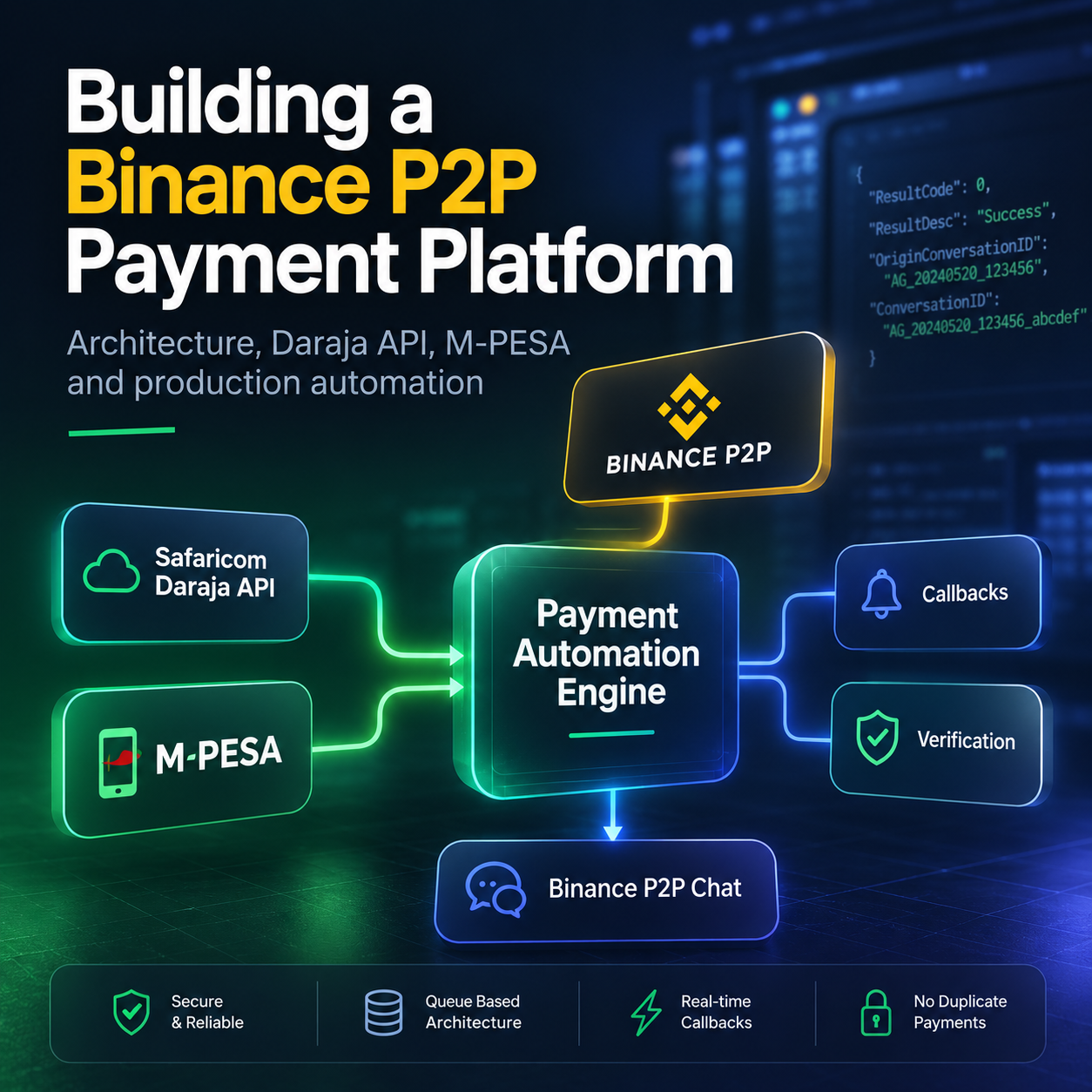
Binance P2P M-PESA Payment Bot for Kenya - Automating Payments with the Safaricom Daraja API
Managing a growing number of Binance P2P trades manually quickly becomes repetitive and time-consuming. Every transaction requires switching between Binance and M-PESA, confirming payments, monitoring transaction status, and updating orders.
Crypto Exchange Fees: Complete Guide for Arbitrage Traders
Every cryptocurrency trade comes with a cost. Whether you're buying Bitcoin, selling USDT or executing a cross-exchange arbitrage strategy, exchanges charge trading fees for processing orders.

Spot Arbitrage Guide
Spot arbitrage is one of the most widely used cryptocurrency trading strategies for taking advantage of temporary price differences between exchanges.

Crypto Arbitrage Risks: Complete Guide to Managing Trading Risks
Crypto arbitrage is often described as one of the lower-risk cryptocurrency trading strategies because it attempts to profit from temporary price differences between exchanges rather than predicting future market direction.

Telegram Alerts: Real-Time Notifications for Crypto Traders
Cryptocurrency markets operate 24 hours a day, making it impossible for traders to monitor every market movement continuously.

Auto Buy: Automated Cryptocurrency Purchasing Explained
Speed is one of the most important advantages in cryptocurrency trading.

Crypto Slippage: What It Is and How to Reduce It
Many cryptocurrency traders calculate potential profit using the market price displayed on their trading platform.

Order Book Depth: Complete Guide to Market Depth Analysis
When beginners first open a cryptocurrency trading platform, they usually focus on a single number—the current market price.

Liquidity Verification: Complete Guide for Crypto Arbitrage
Finding a price difference between two cryptocurrency exchanges is only the first step in identifying a potential arbitrage opportunity.

Spot vs Triangular Arbitrage: Complete Comparison for Crypto Traders
Cryptocurrency arbitrage is based on the idea of profiting from temporary pricing inefficiencies. However, not every arbitrage strategy operates in the same market or follows the same trading process.

Spot vs P2P Arbitrage: Complete Comparison for Crypto Traders
Cryptocurrency arbitrage is not limited to a single trading strategy. Different markets operate under different pricing mechanisms, creating several ways for traders to identify profitable opportunities.

Spot vs Futures Arbitrage: Complete Comparison for Crypto Traders
Cryptocurrency arbitrage is often described as a market-neutral trading strategy because it focuses on price differences rather than predicting whether the market will rise or fall.

Binance vs Bybit Arbitrage: Opportunities, Fees and Trading Guide
Cryptocurrency arbitrage depends on one simple idea: buying an asset on one exchange where it is cheaper and selling it on another where the price is higher.

Crypto Arbitrage Calculator: Complete Guide to Profit Calculation
One of the most common mistakes made by new cryptocurrency arbitrage traders is assuming that every price difference represents a profitable trading opportunity.

Best Crypto Arbitrage Software: Complete Buyer's Guide
Cryptocurrency arbitrage has become increasingly competitive as digital asset markets continue to mature. Opportunities still exist, but finding and evaluating them manually has become far more difficult than it was a few years ago.

SaaS vs Self-Hosted Trading Software: Complete Comparison for Cryptocurrency Traders
Choosing the right trading software is about much more than features. The deployment model behind the software can significantly affect security, privacy, operating costs and the level of control you have over your trading environment.

Self-Hosted Arbitrage Software: Complete Guide for Crypto Traders
Cryptocurrency arbitrage has become increasingly competitive. Professional traders are no longer looking only for profitable price differences—they are also choosing the right infrastructure to execute trades efficiently, securely and with full control over their trading environment.

Withdrawal Networks: Complete Guide to Crypto Transfers Between Exchanges
Moving cryptocurrency between exchanges is one of the most common steps in cross-exchange arbitrage. While many traders focus on prices and trading fees, they often overlook another critical factor: withdrawal networks.

Crypto Transfer Fees: Complete Guide to Blockchain Costs and Arbitrage
Many beginners believe that cryptocurrency arbitrage is simply about buying an asset on one exchange and selling it on another at a higher price. While price differences are important, they represent only one part of the equation.
Opportunity Lifetime: Understanding Arbitrage Timing in Cryptocurrency Markets
One of the biggest misconceptions about cryptocurrency arbitrage is that every profitable opportunity remains available long enough to complete a trade. In reality, arbitrage opportunities are constantly appearing and disappearing as traders execute orders, liquidity changes and exchange prices adjust.

Order Book Arbitrage: Complete Guide to Crypto Market Depth Analysis
Successful cryptocurrency arbitrage involves much more than comparing prices between exchanges. While beginners often focus on finding the largest price difference, professional traders know that profitable opportunities depend on one critical factor: the order book.

Manual Arbitrage: Complete Guide to Finding Crypto Arbitrage Opportunities
Before cryptocurrency arbitrage software became widely available, traders relied entirely on manual market analysis. They compared prices between exchanges, calculated potential profit by hand and decided whether an opportunity was worth executing.

Spot Arbitrage Scanner: Find Crypto Arbitrage Opportunities in Real Time
Cryptocurrency markets move incredibly fast. Price differences between exchanges may exist for only a few seconds before they disappear, making it almost impossible for traders to identify profitable arbitrage opportunities manually.

Spot Arbitrage Software: Complete Guide for Crypto Traders
Cryptocurrency arbitrage has evolved significantly over the past few years. What once involved manually comparing prices on two exchanges has become a highly competitive market where prices, liquidity and trading conditions change within seconds.

Spot Arbitrage: Complete Guide to Cross-Exchange Crypto Trading
Cryptocurrency markets operate 24 hours a day across hundreds of exchanges around the world. Although many traders assume Bitcoin, Ethereum and other digital assets have the same price everywhere, this is rarely the case.

Binance P2P Automation Guide – Complete Resource Hub for Merchants
Binance P2P can be a powerful business opportunity for merchants, but success depends on more than simply creating advertisements and waiting for orders.

How to Export Binance P2P Order History with Full Customer Names
If you regularly trade on Binance P2P, you've probably exported your transaction history at least once. While Binance provides a built-in export feature, many professional merchants quickly discover an important limitation: customer names are partially hidden using asterisks (***).

Best Crypto Exchange for P2P Trading in 2026 – Binance vs Bybit vs OKX
Peer-to-peer cryptocurrency trading continues to grow worldwide, giving traders more options than ever before.

How to Choose a Binance P2P Bot – Complete Buyer's Guide
As Binance P2P becomes increasingly competitive, more merchants are turning to automation tools to improve efficiency, maintain visibility and increase trading volume.

How to Operate Binance P2P 24/7 and Never Miss Orders
One of the biggest challenges for Binance P2P merchants is maintaining competitiveness around the clock.

How to Track Competitors on Binance P2P and Stay Competitive
Competition is one of the biggest factors that affects profitability in Binance P2P trading.

Manual vs Automatic Repricing in Binance P2P – Which Is Better?
One of the most important decisions every Binance P2P merchant faces is how to manage advertisement pricing.

What Is Spread in Binance P2P? Complete Guide for Merchants
One of the most important concepts in Binance P2P trading is the spread.

How to Appear First on Binance P2P and Get More Orders
One of the biggest goals for every Binance P2P merchant is simple: Get more visibility, attract more buyers, and increase trading volume. The reality is that most orders go to merchants whose advertisements appear near the top of Binance P2P search results.

How to Become a Binance P2P Merchant – Complete Beginner's Guide
Binance P2P has become one of the largest peer-to-peer cryptocurrency marketplaces in the world.

Binance P2P API Guide – Complete Merchant Guide
The Binance P2P API is the foundation behind most modern Binance P2P trading bots and automation platforms.

Is It Safe to Use a Binance P2P Bot? Everything You Need to Know
Security is one of the biggest concerns for traders who are considering automating their Binance P2P operations.

How to Configure a Binance P2P Bot Step by Step
Setting up a Binance P2P bot correctly is one of the most important steps for building a profitable and scalable P2P trading operation.

Can You Make Money with Binance P2P? Real Strategies Used by Successful Merchants
Binance P2P has become one of the most popular ways to buy and sell cryptocurrency directly between users. One of the most common questions new traders ask is: Can you actually make money with Binance P2P? The short answer is yes. Thousands of Binance P2P merchants generate profits every day by taking advantage of price differences, trading strategies, and automation tools.

Self-Hosted Binance P2P Bot vs SaaS: Which Option Is Better for Merchants?
As Binance P2P trading continues to grow, merchants face an important decision when choosing automation software.

How Binance P2P Repricing Bots Work
Automatic repricing is one of the most powerful features available in modern Binance P2P bots.

Best Binance P2P Bot 2026 – Complete Comparison Guide
The Binance P2P marketplace has become one of the most popular ways to buy and sell cryptocurrency worldwide. As competition increases, more merchants are turning to automation tools to manage their advertisements, adjust prices in real time, and stay competitive 24/7.

How to Automate Binance P2P Crypto Release via API
Binance P2P Bot Release Crypto API Automation

Binance P2P Receipt Sending with Python WebSocket
Sending Receipt to Sellers About Fund Transfers in Binance P2P Chat Using WebSocket and Python Automation

How to Change Ad Price on Binance Using Python: A Step-by-Step Guide
Programmatically changing the price of an ad on the Binance exchange

Automatic Message Sending to Binance P2P Chat via WebSocket Using Python
Sending Notifications to Sellers About Fund Transfers in Binance P2P Chat Using WebSocket and Python Automation

Flashbots Transaction Sender
Sending flashbot bundles to python. This repository provides a Python script for sending transactions via Flashbots to bypass the public mempool and avoid frontrunning. The script utilizes Web3.py and the Flashbots API to submit bundles directly to miners

FAQ
Frequently Asked Questions
Programming to order: how to order the development of a software product?
If you need to develop a program for your business, contact us and we will implement it
Contact us


