Telegram Alerts: Real-Time Notifications for Crypto Traders
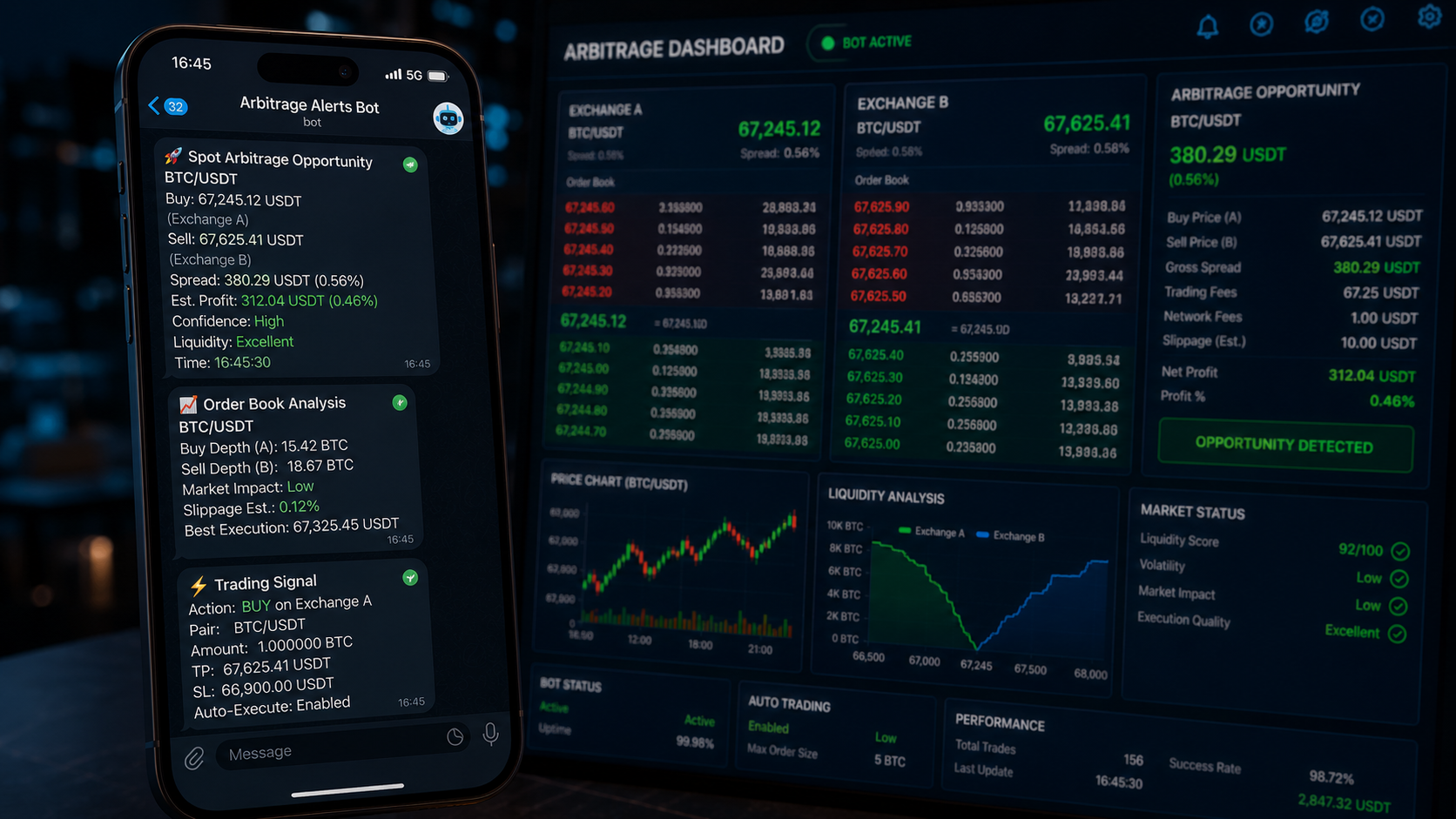
Cryptocurrency markets operate 24 hours a day, making it impossible for traders to monitor every market movement continuously.
Price differences, arbitrage opportunities and new trading events may appear and disappear within seconds.
For this reason, many professional traders rely on Telegram alerts to receive important trading information in real time without constantly watching exchange dashboards.
Telegram has become one of the most widely used notification platforms in cryptocurrency trading because it delivers messages quickly across desktop and mobile devices while supporting automation through bots and APIs.
Whether monitoring spot arbitrage opportunities, Binance P2P activity or general market events, real-time notifications help traders react faster and make more informed decisions.
In this guide, you'll learn how Telegram alerts work, why they are popular among cryptocurrency traders and which types of trading events are commonly delivered through automated notifications.
If you're new to cryptocurrency arbitrage, we recommend starting with our Spot Arbitrage: Complete Guide to Cross-Exchange Crypto Trading.
What Are Telegram Alerts?
Telegram alerts are automated messages sent to Telegram whenever predefined trading events occur.
Instead of manually checking trading platforms, traders receive notifications immediately after important conditions are detected.
Depending on the trading strategy, alerts may include:
- new arbitrage opportunities;
- price changes;
- profitability updates;
- completed trades;
- new P2P advertisements;
- payment confirmations;
- system warnings;
- error notifications.
These alerts allow traders to remain informed even when they are away from their trading workstation.
Why Telegram Is Popular Among Traders
Telegram has become one of the preferred communication platforms for cryptocurrency traders because it combines speed, reliability and broad device support.
Automated trading software can send notifications instantly using the Telegram Bot API, making it easy to monitor trading activity from almost anywhere.
Some of the main advantages include:
- real-time message delivery;
- desktop and mobile applications;
- support for automated bots;
- group and private notifications;
- easy integration with trading software;
- low notification latency.
Because Telegram is widely used within the cryptocurrency community, many professional trading tools support it as a primary notification channel.
Types of Trading Notifications
The exact content of Telegram alerts depends on the trading strategy and software being used.
Common notification categories include:
| Notification Type | Typical Information |
|---|---|
| Arbitrage Opportunity | Exchange prices, spread, estimated profit |
| Price Alert | Target price reached |
| Trade Execution | Successful purchase or sale |
| P2P Activity | New advertisements, payment updates |
| System Status | Errors, warnings, connection events |
Professional traders often configure different notification types depending on the trading strategy they use.
Some alerts require immediate attention, while others simply provide updates about completed actions or changes in market conditions.
Telegram Alerts in Spot Arbitrage
In cross-exchange spot arbitrage, Telegram alerts provide traders with immediate information about newly detected trading opportunities.
Rather than continuously watching multiple exchange interfaces, traders receive important market updates directly in Telegram.
A typical Spot Arbitrage notification may look like this:
🚀 Spot Arbitrage Opportunity

Pair: BTC/USDT

Buy: Binance
Sell: Bybit

Spread: 0.72%

Estimated Profit: $184

Network: TRC20

Liquidity: Good
Depending on the software configuration, alerts may also include:
- order book depth analysis;
- expected profitability;
- estimated slippage;
- withdrawal network;
- opportunity lifetime;
- execution status.
These notifications allow traders to review opportunities immediately and decide whether manual or automated execution is appropriate.
Telegram Alerts in Binance P2P
Telegram plays a different role in Binance P2P trading.
Instead of monitoring exchange order books, notifications focus on newly published merchant advertisements and trading activity.
A typical Binance P2P notification may look like this:
💰 New P2P Advertisement

Coin: USDT

Fiat: EUR

Payment: Revolut

Price: 0.985 EUR

Merchant: Verified

Auto Buy: Ready
Additional notifications may include:
- successful purchases;
- payment confirmations;
- completed orders;
- merchant availability;
- system warnings;
- execution errors.
Because attractive P2P advertisements may disappear quickly, receiving immediate notifications helps traders react before competing buyers secure the available offers.
Real-Time Notifications
The value of Telegram alerts comes from receiving important trading information as soon as market conditions change.
Instead of manually checking exchanges every few minutes, traders are informed automatically whenever predefined conditions are met.
| Spot Arbitrage | Binance P2P |
|---|---|
| New arbitrage opportunity | New P2P advertisement |
| Spread changes | Merchant availability |
| Liquidity updates | Payment status |
| Profitability alerts | Successful purchase |
| Opportunity lifetime | Completed order |
Although the notifications differ, both trading environments benefit from fast, automated communication.
Benefits of Instant Alerts
Instant Telegram notifications provide several practical advantages for cryptocurrency traders.
- Reduced time spent monitoring exchange dashboards.
- Faster reaction to short-lived trading opportunities.
- Immediate awareness of important trading events.
- Continuous monitoring even when away from the computer.
- Better coordination between automated software and manual decision-making.
Telegram alerts do not replace market analysis, but they significantly improve the speed at which traders receive important information.
For strategies where opportunities may exist for only a few seconds or minutes, timely notifications can make a meaningful difference.
Common Mistakes
Telegram alerts are designed to keep traders informed, but they should be viewed as part of a broader trading workflow rather than a complete trading strategy.
Relying Only on Notifications
A Telegram message indicates that predefined conditions have been met, but traders should still understand the market conditions behind the alert.
For example, a profitable spread may disappear before manual execution if market conditions change.
Ignoring Notification Priorities
Receiving too many alerts can make important notifications difficult to identify.
Professional traders typically configure only the alerts that are relevant to their trading strategy.
Expecting Instant Profit
Telegram alerts provide information—not guaranteed profits.
Execution quality still depends on liquidity, market conditions and the trading strategy being used.
Not Configuring Filters Properly
Poorly configured filters may generate unnecessary notifications or cause important trading opportunities to be missed.
Carefully selecting trading pairs, payment methods, fiat currencies and profitability thresholds helps improve notification quality.
Ignoring System Notifications
Connection problems, API errors and execution failures are just as important as opportunity alerts.
Monitoring system status helps traders identify issues before they affect trading performance.
Frequently Asked Questions
What are Telegram alerts in crypto trading?
Telegram alerts are automated notifications sent when predefined trading events occur, such as new arbitrage opportunities, P2P advertisements or completed trades.
Why do cryptocurrency traders use Telegram?
Telegram delivers real-time notifications across desktop and mobile devices while supporting reliable integration with automated trading software through bots and APIs.
Can Telegram alerts be used for spot arbitrage?
Yes. Spot arbitrage software can notify traders about new opportunities, profitability, liquidity conditions, spread changes and opportunity lifetime.
Can Telegram alerts be used with Binance P2P?
Yes. Binance P2P automation can send notifications about newly published advertisements, successful purchases, payment status, completed orders and system events.
Do Telegram alerts execute trades automatically?
Not necessarily. Some systems use Telegram only for notifications, while others combine alerts with automated trading features such as Auto Buy.
Can Telegram alerts reduce missed opportunities?
Yes. By delivering information immediately after important trading events occur, Telegram alerts help traders respond faster than periodic manual monitoring.
Continue Learning About Automated Trading
- Auto Buy
- Spot Arbitrage: Complete Guide to Cross-Exchange Crypto Trading
- Spot Arbitrage Scanner
- Spot Arbitrage Software
- Manual Arbitrage
- Order Book Depth
- Liquidity Verification
- Crypto Slippage
- Crypto Arbitrage Calculator
Spot Arbitrage Screener with Telegram Alerts
Spot Arbitrage Screener uses Telegram to deliver real-time notifications whenever important market events occur.
Typical Telegram alerts include:
- new arbitrage opportunities;
- spread changes;
- liquidity status;
- estimated profitability;
- opportunity lifetime;
- Auto Buy status (when enabled).
Instead of constantly monitoring exchange dashboards, traders receive actionable market information immediately after the software detects significant trading opportunities.
Binance P2P Bot with Telegram Notifications
Binance P2P Bot uses Telegram to keep traders informed about activity on the Binance P2P marketplace.
Typical Telegram notifications include:
- new P2P advertisements;
- successful cryptocurrency purchases;
- payment status updates;
- completed orders;
- system errors and notifications;
- Auto Buy activity.
Rather than monitoring Binance P2P continuously, traders receive immediate updates whenever the bot detects relevant advertisements, completes purchases or requires attention.
Looking for Integration & API Docs?
Explore our official technical reference for Binance SAPI endpoints, including C2C ads management, deposit/withdrawal logs, automated payout webhooks, and REST API examples.
Explore Binance API Documentation→Part of the Spot Arbitrage Guide
This article is part of our complete learning guide covering professional cross-exchange cryptocurrency arbitrage.
Explore the Spot Arbitrage Guide→Part of the Binance P2P Automation Guide
This article is part of our complete learning guide covering Binance P2P automation, merchant tools, and automated trading.
Explore the Binance P2P Automation Guide→