Hunting Seven Digits: How We Built a Binance P2P Auto-Release System for M-Pesa
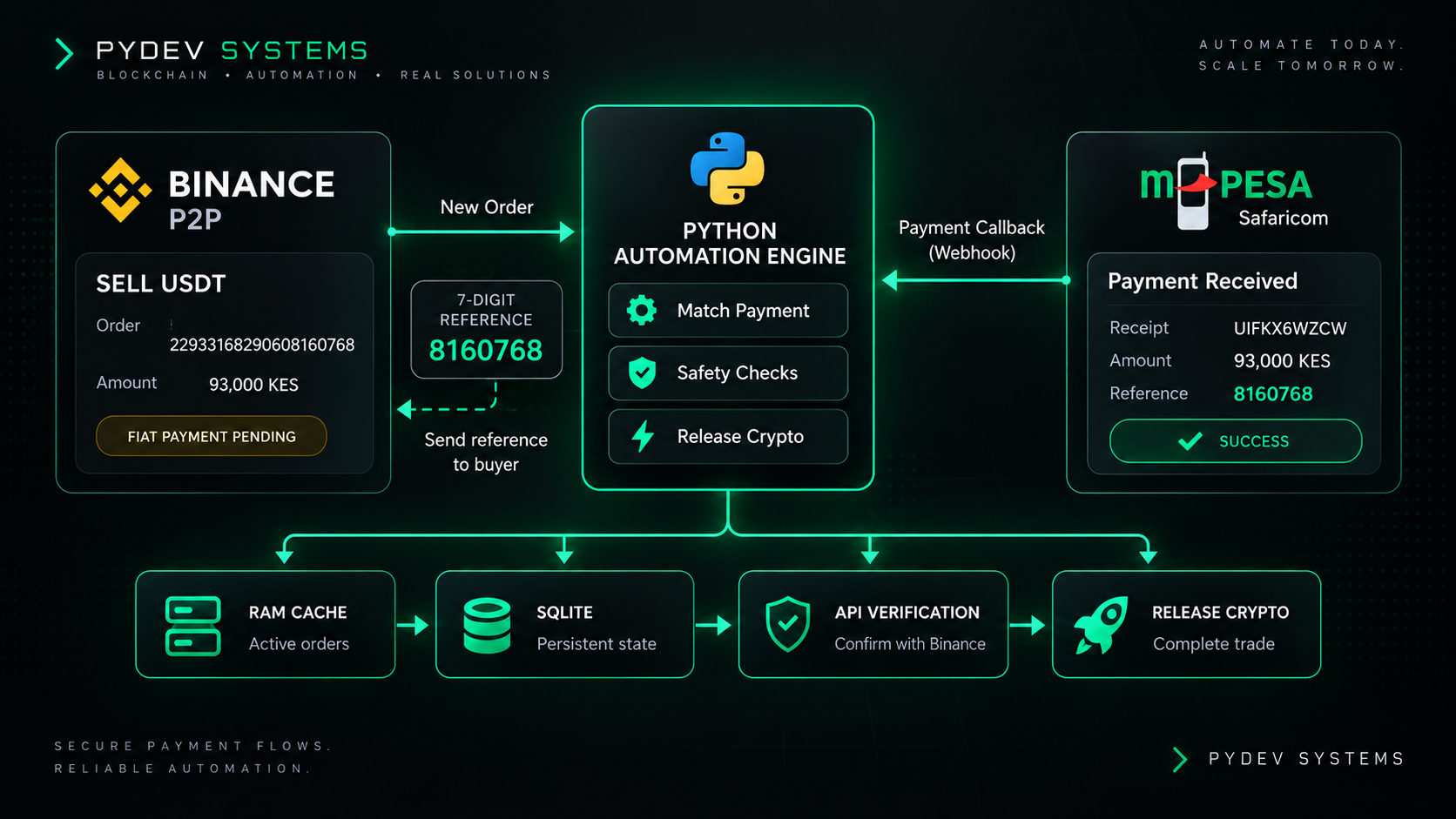
P2P payment automation sounds simple until real money enters the system. Detect an order, receive a payment notification, match the payment and release the cryptocurrency. In theory, the entire workflow fits into a few lines on a whiteboard.
In production, we had Binance P2P on one side, Safaricom M-Pesa and Daraja on the other, and a real buyer in the middle who could take several minutes to complete a payment, mistype a reference or simply behave in a way no test environment predicted.
This is the engineering story behind a Binance P2P auto-release system: how seven digits became the bridge between an exchange order and an M-Pesa payment, how a race condition almost broke that bridge, and how persistent state turned a fragile automation script into a much more resilient payment engine.
Act I · The Problem
Why Binance P2P Automation Is Harder Than It Looks
A P2P merchant depends heavily on execution speed. The faster fiat payments can be verified and completed orders can move through the workflow, the less operational overhead is required to process a large number of trades.
A manual Binance P2P transaction involving M-Pesa typically looks like this:
01
The buyer opens a Binance P2P order and the cryptocurrency is held in escrow.
02
The buyer sends Kenyan shillings through M-Pesa to the merchant's Till or Paybill account.
03
The merchant verifies that the payment was actually received.
04
The payment amount and reference are matched against the correct exchange order.
05
The merchant releases the cryptocurrency and completes the trade.
At 10 or 20 transactions per day, manual processing may still be manageable. At hundreds of orders, repetitive verification becomes a serious operational bottleneck. The goal was therefore much more ambitious: automate the complete payment-to-release lifecycle while keeping release decisions strictly verified.
Act II · Architecture
Building an Event-Driven Binance P2P Payment Engine
The system was designed as an event-driven service connecting exchange order events with incoming M-Pesa payment callbacks.
The architecture was straightforward. The difficult question was how to reliably associate an asynchronous M-Pesa payment with the correct Binance P2P order.
The Seven-Digit Problem
Matching an M-Pesa Payment to a Binance Order
Binance order numbers are not designed for humans typing references into mobile payment applications. A real order identifier can look like this:
22933168290608160768M-Pesa provides a reference field such as BillRefNumber. Asking a buyer to manually enter a 20-digit exchange identifier on a smartphone proved unrealistic. References could be mistyped, replaced with phone numbers or filled with unrelated text.
Engineering Decision
Use a deterministic seven-digit suffix
For order 22933168290608160768, the payment reference becomes:
8160768
As soon as a new SELL order was detected, the bot sent the buyer a message containing the seven-digit payment reference. This dramatically simplified the mobile payment flow while preserving a deterministic link back to the full exchange order identifier.
Act III · Production Failure
Then Production Broke the Perfect Design
One evening, the safety system suspended an automatic release because it believed an incoming M-Pesa payment contained an invalid reference.
! Auto-Release Suspended (Action Required)
Reason: Missing or invalid BillRefNumber

M-Pesa Payment:
Receipt: UIFKX6WZCW
Amount: 93000.00 KES
Ref: 8160768
There was only one problem with the error message: the reference was correct.
The payment amount was correct. The M-Pesa reference was 8160768. The Binance order existed and ended with exactly the same seven digits. Yet the matching engine refused to release.
Act IV · Debugging
The Logs Revealed a Race Condition
The only way to understand the failure was to reconstruct the exact event sequence from the service logs.
journalctl -u MpesaP2PayBot.service --since "2026-09-15 16:20:00"
16:24:22
Binance WebSocket reports a new SELL order ending in 8160768.
16:24:25
The bot sends payment reference 8160768 to the buyer.
16:24:50
The background order checker still sees the order in the active set.
16:25:21
The order disappears from the current in-memory active order collection.
16:27:57
M-Pesa finally sends the payment callback — roughly two and a half minutes later.
16:27:57
The matching engine searches for suffix 8160768, but the corresponding order is no longer present in its RAM cache.
Root Cause
The payment was valid. The reference was valid. The order was valid. The local representation of the order was temporarily stale.
Act V · Root Cause
Why the In-Memory Cache Failed
The original matching implementation searched the current in-memory order list for an order number ending with the supplied reference:
raw_active = getattr(self.binance, "orders", [])
active_list = [o for o in raw_active]

if clean_ref:
    for o in active_list:
        cand_no = str(o.get("orderNumber", ""))

        if cand_no.endswith(clean_ref):
            matched_order = self.binance.getUserOrderDetail(cand_no)
            break

    if not matched_order and len(clean_ref) >= 15:
        matched_order = self.binance.getUserOrderDetail(clean_ref)
The flaw was subtle. Direct order lookup was available only when the reference contained a nearly complete order number. Our seven-digit reference therefore depended entirely on the temporary contents of the in-memory active order list.
A WebSocket reconnect, incomplete polling response, pagination timing or another synchronization event could temporarily remove an otherwise valid order from that collection. If the payment callback arrived during that window, matching failed.
Engineering Lesson
In-memory state is a performance optimization. It should not be the only source of truth for a financial workflow.
Act VI · The Fix
Persistent State with SQLite and API Verification
The answer was not to poll Binance more aggressively. More polling would increase API traffic without fixing the architectural weakness.
The system already maintained SQLite persistent storage in WAL mode for discovered orders. The matching engine simply needed to use it as a fallback when runtime state could not resolve the seven-digit reference.
LEVEL 01
RAM Cache
Fast lookup for currently synchronized active orders.
LEVEL 02
SQLite
Persistent lookup when the order temporarily disappears from runtime state.
LEVEL 03
Binance API
Verify the recovered full order number against current exchange state.
for o in active_list:
    cand_no = str(o.get("orderNumber", ""))

    if cand_no.endswith(clean_ref):
        matched_order = self.binance.getUserOrderDetail(cand_no)

        if matched_order:
            break

if not matched_order:
    try:
        from app.orders_state import get_connection

        with get_connection() as conn:
            row = conn.execute(
                "SELECT order_number FROM orders "
                "WHERE order_number LIKE ? "
                "ORDER BY created_at DESC LIMIT 1;",
                (f"%{clean_ref}",)
            ).fetchone()

            if row:
                found_order_no = row["order_number"]
                matched_order = self.binance.getUserOrderDetail(found_order_no)

    except Exception as ex_db:
        log.logging(f"[MATCHING ENGINE DB FALLBACK ERROR] {ex_db}")
The important distinction is that SQLite does not authorize the release by itself. It recovers the full order identifier. The current order state can then be checked against Binance before the release workflow proceeds.
Safety Model
Fast Automation Must Still Fail Closed
The objective of an auto-release system is not to release cryptocurrency as fast as technically possible. It is to release it as fast as possible after the payment and order have been verified.
Payment Reference
The incoming reference must resolve to a known order.
Payment Amount
The received fiat amount must correspond to the expected transaction.
Exchange State
The order must still be in a state where the release operation is valid.
Idempotency
The same payment event or release action must never be processed twice.
Act VII · Full Lifecycle
Automation Does Not End at Crypto Release
Once the exchange reports the order as completed, the workflow can continue with post-trade communication. Instead of requiring the merchant to manually send the same message after every successful trade, a background worker can respond to the completed-order event.
✅ Trade completed successfully.

Thank you for trading with us!

⭐ If you are satisfied with the fast transaction,
we'd appreciate your positive feedback.

See you again!
At that point the workflow covers the complete operational cycle: order detection, payment instructions, M-Pesa callback processing, resilient matching, exchange verification, crypto release and post-trade communication.
Engineering Notes
Four Lessons from Building Financial Automation
01
Never Treat RAM as Your Only Source of Truth
WebSockets reconnect. APIs return incomplete snapshots. Timing changes. Persistent state gives asynchronous financial events somewhere reliable to meet.
02
Design for Human Error
Twenty-digit exchange IDs may be perfect machine identifiers but terrible mobile payment references. Simplifying the user-facing input is valuable, provided the backend performs strict verification.
03
Logs Are Part of the Architecture
Timestamped event logs made it possible to reconstruct a failure spanning Binance events, local state changes and an M-Pesa callback several minutes later.
04
Idempotency Is Non-Negotiable
Payment callbacks may be retried and asynchronous events may be delivered more than once. A financial system must ensure that one payment cannot trigger duplicate accounting or duplicate release actions.
Conclusion
Production Fintech Is Built Around Failure
The interesting part of this project was never the API call that releases cryptocurrency. The difficult part was proving that the system had enough reliable information to make that call safely.
A buyer taking two extra minutes to enter an M-Pesa PIN exposed a weakness that no happy-path test had revealed: two asynchronous systems were being connected through temporary runtime state.
Reliable financial automation is not software that assumes everything stays synchronized. It is software designed around the fact that eventually, something will not.