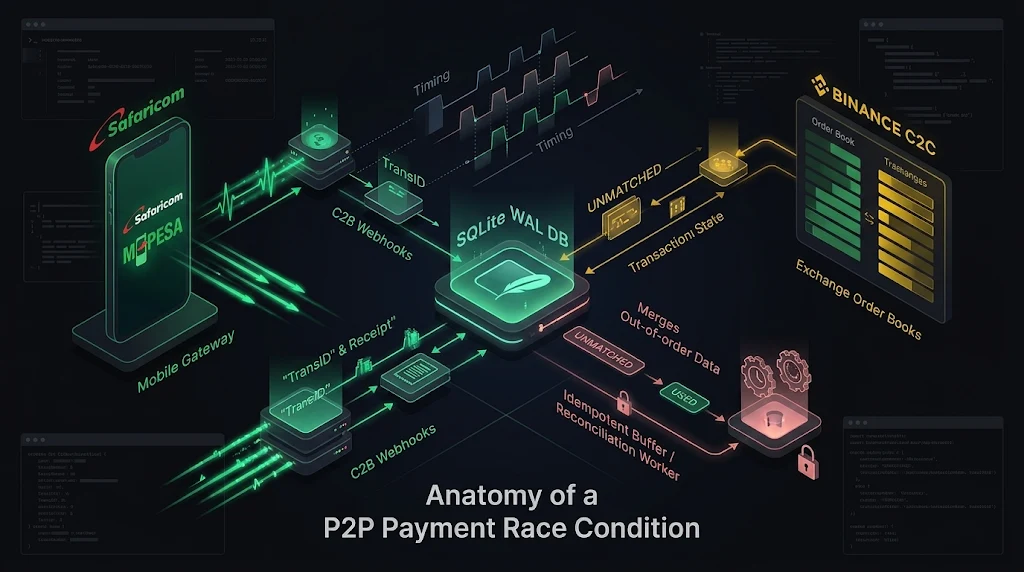
In high-frequency peer-to-peer (P2P) crypto-fiat automation, most production failures do not come from syntax errors or network outages. They emerge from distributed timing edge cases: fiat payment rails operate asynchronously from exchange order books, mobile money gateways fire webhooks milliseconds after a transfer settles, and human buyers rarely click UI buttons in the exact sequence an API flow assumes.
This engineering post-mortem examines three real-world failure modes encountered while running a live Binance P2P M-Pesa payment automation bridge connecting Binance C2C (P2P) with Safaricom M-Pesa (C2B/B2C)—and the fault-tolerant architecture patterns used to eliminate them.
01 / Asynchronous Event Ordering
The Out-of-Order Webhook Race Condition
In a standard P2P sell flow, the expected sequence is straightforward:
- A buyer opens an order on the exchange.
- The buyer transfers fiat via mobile money (
M-Pesa PayBillorTill). - The buyer clicks "Transferred, Notify Seller" on the exchange.
- The exchange updates the order state to
Buyer Paid, and the automation engine releases the escrowed crypto upon verifying the incoming payment.
In production, fast buyers routinely invert steps 2 and 3—or execute the mobile transfer within seconds of order creation, before the exchange WebSocket or polling loop has even cached the new order locally.
What Happens Without Buffering
When Safaricom's C2B confirmation webhook hits the server 500ms after the transfer, a naive stateless handler queries the local order cache, finds no matching Buyer Paid order, and either drops the callback or raises a false mismatch alert. Worse, if the mobile money gateway retries the webhook later, an unguarded endpoint risks double-crediting or double-releasing funds.
Solution: SQLite WAL Buffering + Idempotent Reconciliation Loop
Instead of treating an incoming payment webhook as a synchronous pass/fail check against the order book, decouple payment ingestion from order reconciliation:
- 1. Immediate Idempotent Persistence: Every incoming C2B webhook is committed immediately to an SQLite database running in Write-Ahead Logging (
WAL) mode, keyed by the unique mobile money transaction receipt (TransID). Duplicate webhook deliveries are safely ignored at the storage layer. - 2. State-Driven Pool (
UNMATCHED → USED): If no eligible exchange order exists at the exact millisecond the webhook arrives, the transaction remains safely buffered in anUNMATCHEDpool rather than being discarded. - 3. Background Reconciliation Worker: A dedicated background worker polls pending exchange orders every few seconds and runs a thread-locked reconciliation pass across the buffered
UNMATCHEDpool. The moment the buyer clicks "Transferred" (or the order cache syncs), the engine matches the buffered receipt and triggers the release.
reconciler.py — Python (SQLite WAL)
import sqlite3
import threading
import time


class PaymentReconciler:
    def __init__(self, db_path: str):
        self.db_path = db_path
        self._lock = threading.Lock()

    def _connect(self) -> sqlite3.Connection:
        conn = sqlite3.connect(self.db_path, timeout=30.0, check_same_thread=False)
        conn.row_factory = sqlite3.Row
        conn.execute("PRAGMA journal_mode=WAL;")
        conn.execute("PRAGMA synchronous=NORMAL;")
        return conn

    def ingest_webhook(self, receipt_id: str, amount: float, sender_name: str) -> bool:
        """Idempotently stores an incoming fiat webhook before matching."""
        with self._connect() as conn:
            cursor = conn.execute(
                """
                INSERT OR IGNORE INTO c2b_transactions (receipt_id, amount, raw_name, status)
                VALUES (?, ?, ?, 'UNMATCHED')
                """,
                (receipt_id.strip(), round(amount, 2), sender_name.strip()),
            )
            return cursor.rowcount == 1  # False if duplicate webhook

    def reconcile_loop(self, fetch_active_orders_fn, release_fn):
        """Continuously reconciles buffered fiat receipts against newly updated orders."""
        while True:
            try:
                with self._lock:
                    orders = fetch_active_orders_fn()
                    if orders:
                        self._match_orders_fifo(orders, release_fn)
            except Exception as exc:
                print(f"[RECONCILE ERROR] {exc}")
            time.sleep(10)
02 / Identity & Collision Safety
Deterministic Name Verification & Collision Guards
Automated crypto release carries irreversible financial risk: once escrowed USDT is released on-chain or internally on an exchange, a reversed or third-party fiat transfer cannot be clawed back easily. At the same time, real-world KYC strings rarely match mobile money sender fields character-for-character:
Partial vs. Full Names
Mobile money C2B callbacks often transmit only the first legal name (ALICE or OSCAR), whereas exchange KYC profiles store the full legal name (ALICE WANJIKU MWANGI).
Concatenated KYC Tokens
Buyers occasionally register exchange KYC profiles with two names concatenated without whitespace (REGINAJOY), while the telecom provider reports REGINA.
Non-Latin Scripts
A buyer whose exchange KYC is registered in Arabic or Cyrillic script cannot be deterministically matched against an uppercase Latin telecom string without risking false positives.
Amount Collisions
Two different buyers may open separate orders for the exact same round amount (e.g., 6,000 KES) within the same minute.
Multi-Tier Matching with Ambiguity Blocking
A production-grade matcher enforces strict financial boundaries before attempting heuristic name normalization:
- 1. Exact Fiat Amount & FIFO Ordering: Active
SELLorders are sorted chronologically by creation timestamp (createTimeascending). Partial payments are either accumulated explicitly under split-payment rules or held back—never auto-released on an underpayment or overpayment. - 2. Tokenized Name Normalization: Both the telecom sender string and the exchange KYC name are stripped of punctuation, uppercased, and split into tokens. A match succeeds if every telecom token matches a KYC token (or a valid
≥ 4-character prefix/suffix for concatenated KYC names). - 3. Ambiguity Guard: If a single buffered receipt matches more than one active order (for example, two simultaneous orders of identical value from buyers sharing a first name), the engine aborts auto-release and escalates to manual review.
kyc_matcher.py — Deterministic Token Matcher
import re


def normalize_tokens(raw: str) -> list[str]:
    cleaned = re.sub(r"[^A-Z0-9\s]", " ", raw.upper())
    return [tok for tok in cleaned.split() if tok]


def is_kyc_name_match(mpesa_name: str, binance_kyc: str) -> bool:
    sender_tokens = normalize_tokens(mpesa_name)
    kyc_tokens = normalize_tokens(binance_kyc)

    if not sender_tokens or not kyc_tokens:
        return False

    for s_tok in sender_tokens:
        matched = any(
            s_tok == k_tok
            or (len(s_tok) >= 4 and (k_tok.startswith(s_tok) or k_tok.endswith(s_tok)))
            for k_tok in kyc_tokens
        )
        if not matched:
            return False
    return True
03 / Infrastructure & Reliability
Surviving Process Restarts & Routine Server Maintenance
In production fintech environments, background worker restarts are inevitable—whether triggered by container orchestration, systemd watchdogs, or routine OS security updates (apt upgrade and needrestart).
If active exchange orders are stored exclusively in process RAM (active_orders), any brief daemon restart creates a temporary blind spot until the next exchange API sync completes. Designing the automation layer to be stateless in memory—and combining it with disciplined maintenance windows—eliminates dropped webhooks across restarts.
ARCHITECTURE BEST PRACTICE
Persist Active Order State to SQLite
Mirror active order IDs and metadata into a lightweight orders table in SQLite (WAL mode) immediately upon detection rather than relying solely on in-memory dictionaries. On startup, the reconciliation worker reloads open orders directly from disk with zero cold-start lag.
DEPLOYMENT HYGIENE
Pre-Maintenance Ad Pause Protocol
Before deploying code updates, upgrading OS packages, or rebooting a production host, switch P2P merchant advertisements to Offline (Paused) and let in-flight trades settle. Draining active orders first guarantees clean maintenance windows with zero webhook contention.
✓ Takeaways for Fintech & P2P Engineers
- Never rely on synchronous webhook-to-order matching. Buffer every incoming payment event idempotently in durable storage first, then reconcile asynchronously.
- Treat any ambiguity as a hard stop. Strict amount equality, non-Latin script isolation, and multi-order collision checks prevent costly false releases.
- Keep stateful caches on disk, not just in RAM. Combining SQLite WAL persistence with
systemdsupervision ensures your automation survives unexpected service restarts without dropping live transactions.